Igniting business
success in Dubai
Speak with a setup specialist about the right structure for your venture.
Starting a commercial venture in the UAE is easily one of the most thrilling moves an entrepreneur can make. But getting caught up in avoidable legal blunders can turn that big dream into a painfully expensive headache.
Dubai’s commercial ecosystem moves fast. While the regulatory system is remarkably efficient and transparent, it is also strictly enforced. When founders make missteps during company formation, it isn't usually out of bad intent, it’s because they acted on outdated advice, rushed their paperwork, or didn't grasp how local laws operate on the ground.
If you are planning to launch, dodging these critical legal traps early on will save you a world of time, money, and frustration.
One of the most frequent errors entrepreneurs commit when planning a business setup in Dubai is picking a jurisdiction based purely on upfront registration costs rather than real-world operational needs.
When looking at business set up Dubai options, you generally decide between two main routes:
Mainland (Department of Economy and Tourism - DET): Allows you to trade freely anywhere across local UAE markets, bid on government projects, and open retail doors on any street or mall.
Free Zones: Offer perks like streamlined digital setup and customs exemptions, but they come with commercial geographic boundaries.
If you register inside a Free Zone but start delivering direct services or physical products onshore to mainland clients without an approved local branch license or distributor, you are operating outside your legal boundaries. Municipal inspectors won't hesitate to hand out heavy fines for that.
When applying for business set up in dubai approvals, you have to pick specific activity codes that mirror what your company actually does day-to-day. Every single invoice you hand out and every vendor contract you sign needs to match those registered activities.
A common mistake is picking a cheap and generic trading code while actually having specialized consulting, health services or real estate management. If an audit or customer dispute happens and reveals that your income comes from unlisted activities, regulators can suspend your trade license and impose severe penalties.
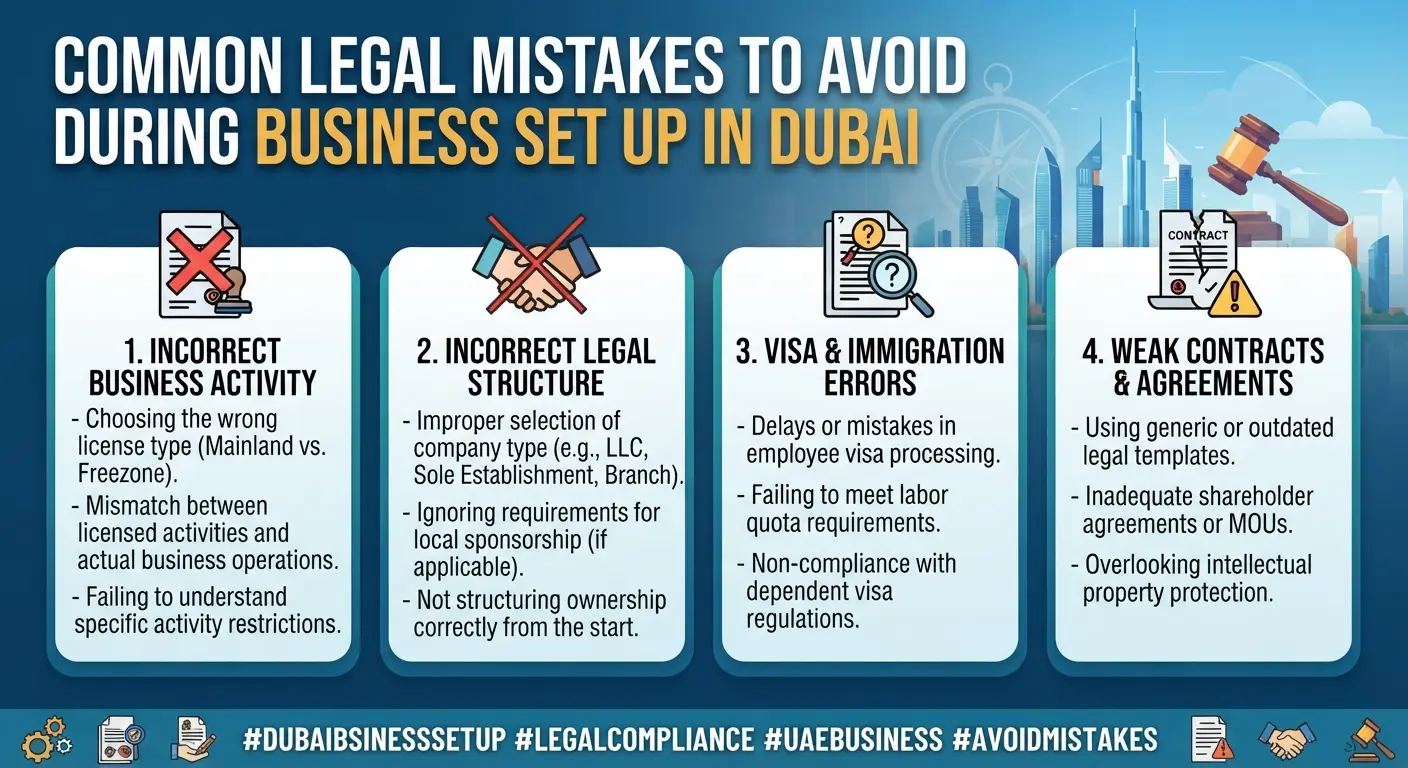
Thanks to major updates in local company law, foreign founders can now keep 100% full ownership of mainland companies across thousands of commercial sectors without needing a local majority partner.
Even so, founders organizing a Dubai business setup still walk into internal legal traps:
Informal Side Letters: Some business owners still try to make private, informal deals with third parties about ownership or profit cuts that contradict their official Memorandum of Association (MOA). Local courts prioritize the official notarized MOA over private side notes every single time.
Vague Decision Rules: Partners often skip writing down clear exit strategies, capital call rules, or dispute resolution steps. When a disagreement pops up down the road, the lack of a proper legal agreement can completely freeze operations.
Building out your team is a massive milestone, but local labor laws are strict. Violations here quickly lead to hefty labor fines and legal friction.
The biggest errors to steer clear of include:
Early Work Starts: Letting new hires start working on a visit visa or an old residence permit while waiting for their new permit to come through. Work permits must be active before anyone officially begins work.
Non-Standard Contracts: Relying on generic offer templates downloaded off the internet instead of filing official labor contracts through the Ministry of Human Resources and Emiratisation (MOHRE).
Bypassing WPS: Failing to run staff salaries through the government-mandated Wages Protection System (WPS) portal. Skipping WPS cycles blocks your company from issuing any new work visas.
Whether you are leasing a physical showroom or taking space in an office tower, a commercial lease is a serious legal commitment.
Plenty of founders sign lease paperwork before confirming if the space actually meets the legal specifications for their exact line of work. For instance, trying to set up a commercial kitchen, medical clinic, or gym in a building that lacks proper civil defense clearance or drainage infrastructure will get your license application flat-out rejected. Always make sure your lease gets registered on the Ejari system for mainland setups before finalizing long-term commitments.

The days of operating completely tax-free without bookkeeping in the UAE are long gone. Keeping your company on the right side of the law requires clean accounting and strict compliance with federal tax rules.
Avoid these frequent financial slip-ups:
Ignoring Corporate Tax Filings: Standard corporate tax sits at 9% on net profits above AED 375,000. Even if your business earns under that limit or operates in a Free Zone, submitting an annual corporate tax return remains mandatory.
VAT Registration Lapses: Once your taxable supplies and imports go past AED 375,000 over 12 months, registering for 5% VAT with the Federal Tax Authority (FTA) is required by law. Late registration brings mandatory penalty fees.
Anti-Money Laundering Neglect: High risk sectors like real estate, metal trading, accounting, and corporate services must register on the government goAML portal and maintain strict records.
When searching for a business setup company in dubai to help with the paperwork, entrepreneurs sometimes end up with cheap and unregistered brokers promising shortcuts.
Working with an unverified advisor often leads to incorrect document filings, hidden fees, fake approvals, and major registration delays. Always double check that your chosen consultant holds a valid management consulting or corporate services license from official licensing bodies.
Setting up a business in Dubai gives you access to a phenomenal global gateway, provided you lay down solid legal foundations right from the start. Taking the time to pick the right jurisdiction, register your exact activities, follow employment guidelines, and stay on top of local tax rules guarantees that your business stays built for long-term growth rather than unexpected legal hurdles.
Yes. Under updated commercial regulations, foreign entrepreneurs can retain 100% full ownership of mainland companies across thousands of commercial, professional, and industrial activities without requiring a local majority sponsor.
Operating outside the bounds of your trade license activities is illegal. Economic inspectors run routine compliance checks, and businesses caught carrying out unlisted activities face heavy administrative fines, potential trade license suspensions, and holds on visa processing.
Yes. Even though net profits up to AED 375,000 are taxed at a 0% rate, every registered commercial entity across the UAE must register for corporate tax and submit an annual tax filing to the FTA.