Igniting business
success in Dubai
Speak with a setup specialist about the right structure for your venture.
When you look at expanding a business into the Middle East, the same question always comes up: why does everyone keep picking Dubai over every other city or emirate in the region?
It is not just effective marketing or impressive skyline photos. If you are running a company, whether that is a software business, a physical trading operation, an e-commerce brand, or a consulting firm—where you legally register matters just as much as what you sell. You want an environment that gets out of your way, lets you keep your margins, and makes doing business straightforward.
When you weigh up the options across the UAE, deciding to go through a business setup in Dubai comes down to a few very specific, practical reasons that directly impact how you run your business month to month.

One of the biggest advantages of setting up here instead of other parts of the region is the flexibility in how you structure your company. You are not forced into a single legal box. You get to choose between two main paths depending on who your actual customers are.
If your primary focus is international clients, digital services, or online sales, setting up in a Free Zone is usually the most straightforward option. They give you full foreign ownership, zero currency restrictions, and virtual office options that keep your overhead low. You get a fully recognized legal setup without having to pay heavy monthly rent on a physical commercial office space you do not actually need.
On the other hand, if you want to open physical shops, lease local warehouse space, or bid directly on local government projects inside the UAE, you can set up directly on the Mainland through the local Department of Economy and Tourism. In the past, foreign owners needed a local partner to hold majority shares for a mainland license, but recent law changes mean foreign owners can hold 100% equity on most standard commercial licenses today.
Having both options side by side means you can tailor your setup to your exact business model rather than altering your model to fit local rules.
Let us be completely realistic: the financial side is a massive reason people move their company base here. While many Western countries keep raising corporate tax rates and piling on extra compliance costs, the UAE maintains a system designed to encourage growth. There is zero personal income tax, zero dividend tax, and zero capital gains tax.
When it comes to corporate earnings, the federal corporate tax sits at a flat 9%. However, it only kicks in on net taxable profits that pass 375,000 Dirhams (around $102,000 USD). Everything you make up to that threshold stays taxed at 0%.
Beyond the tax rates, the local currency (the Dirham) is pegged straight to the US Dollar. If you deal with international clients in USD, EUR, or GBP, having your primary corporate account tied to a dollar-pegged currency means you are not constantly watching your cash reserves swing up and down based on currency markets.
When you sit down with a solid business setup company in Dubai to map out your corporate structure, you get to build a clean, compliant model that lets you keep the vast majority of your revenue to put back into hiring, product development, or marketing.
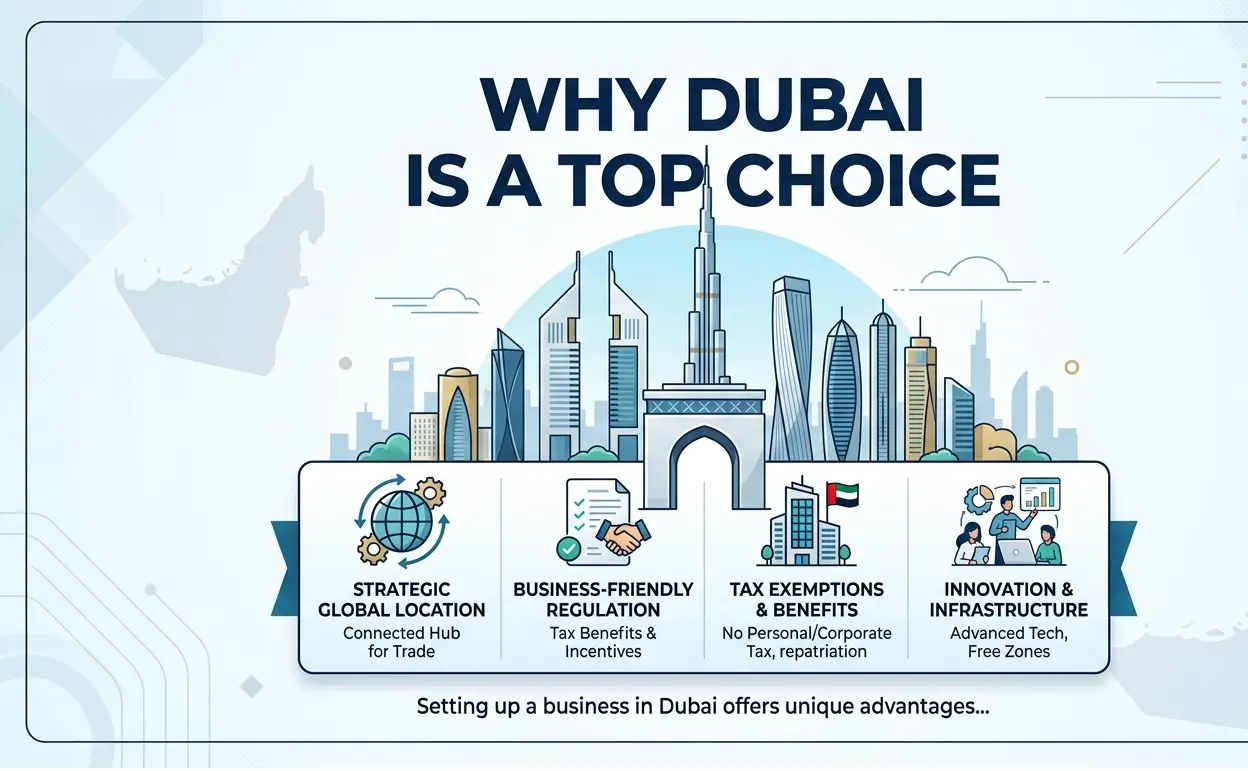
If your market stretches across multiple countries, location is everything. Sitting in the middle of Europe and Asia and Africa, the city lets you communicate with teams and clients in different time zones across a normal working day. Within an eight hour flight, you can reach most parts of the world. For physical product brands, logistics hubs like Dubai International Airport and the port at Jebel Ali handle enormous trade volumes every single day.
Even for digital companies, being located in Dubai makes it easier to meet partners, attend global industry events and build international relationships without spending half your year on grueling multi-stop flights.
A company is only as good as the team behind it. One problem with setting up in smaller or more isolated commercial hubs is trying to convince senior talent, developers, or managers to move there with you.
The UAE makes bringing in talent straightforward through flexible residency options. With long-term Golden Visas for investors, executives, and specialists, alongside standard workplace visas and freelancer permits, building an international team is relatively simple.
When you add high safety standards, strong public infrastructure, modern healthcare and great lifestyle options, attracting qualified professionals from all over the world becomes much easier.
While the registration process is modern, getting your administrative steps right from day one saves you time and money. Working through your business set up in dubai step by step keeps everything on track:
First, you define your exact business activities. The local authorities require you to select specific activities from an official list, whether that is management consulting, software development, or e-commerce.
Next, you reserve your trade name. You submit three name choices that follow local guidelines, no vulgarity, no political references, and no abbreviations of famous global brands.
After that, you submit your shareholder documentation. For standard setups, this usually means providing clear passport copies, passport photos, and a basic proof of address.
Finally, once the authority reviews and approves your file, you pay your government fees online. Your trade license, articles of association, and registry documents are issued, giving you the official paperwork needed to set up corporate bank accounts and begin trading.
Choosing this location gives your business a fast, flexible, and tax-efficient foundation. You get to operate out of a modern, forward-thinking hub that is built from the ground up to help companies scale.
Dubai has become a popular destination for entrepreneurs because it offers flexibility in company structure, access to international markets, modern infrastructure, and a business environment designed around global commerce.
Whether you are building an online company, expanding an existing operation, trading internationally, or establishing a new venture, understanding the available Free Zone and Mainland options is an important first step toward creating the right structure for your business.
No. Foreign owners can hold 100% equity in Free Zone companies and on the vast majority of Mainland commercial licenses without needing a local majority shareholder.
Yes. Every registered corporate entity in the UAE needs to register for corporate tax and receive a tax number, even if its profits fall below the 375,000 AED taxable limit.
A Free Zone company is generally best for international trade, online platforms, and services, offering fast digital setups and flexible virtual offices. A Mainland company lets you trade directly inside the local domestic retail market and take on local government contracts.
Yes. Once your corporate license is active and you receive your residence visa, you can sponsor your spouse, children, and domestic staff for their local residence visas.